
About Eric Reeves
I first began turning wood many years ago, but returned seriously to the lathe in 1992 after an absence of roughly twenty-five years. I am largely self-taught, although over the years I have learned enormously from looking closely at the work of other turners and, when possible, from working with them. Two influences have been especially important: David Ellsworth, whose pioneering work in hollow-form turning helped transform contemporary woodturning, and the late British turner Bert Marsh, whose extraordinary sensitivity to line, proportion, and simplicity continues to shape the way I think about form.
My work has evolved considerably over the years, but I have remained fascinated by the fundamental problem that confronts every woodturner: how much should the turner impose upon the wood, and how much should the wood determine the final object? A beautiful piece of wood already contains an enormous amount of visual information—grain, figure, color, inclusions, spalting, natural edges, sometimes cracks and other apparent “defects.” The challenge is not simply to reveal these qualities, but to create a form in which they become coherent. At its best, I think, woodturning is a collaboration between material and maker.
I turn bowls, vessels, hollow forms, platters, and smaller sculptural pieces, working with both domestic and exotic woods. Over the years these have included cherry, maple and other familiar North American species, as well as African blackwood, cocobolo, bocote, bubinga, camphor burl, buckeye burl, East Indian rosewood, mallee burl, and many others. Burls particularly fascinate me because of their extraordinary figure and unpredictability. I often incorporate contrasting woods, delicate finials, laminations, and occasionally metal or other forms of inlay. But ornament must finally serve the form: I want the eye to encounter the piece first as a whole and only afterward discover the details of its construction.
Hollow forms have occupied a particularly important place in my work. They involve the slightly improbable process of turning and hollowing a substantial piece of wood through a relatively small opening, leaving a vessel whose external form gives little indication of the difficulty of its construction. But the technical accomplishment matters much less to me than the resulting shape. A successful hollow form should not announce how difficult it was to make. It should simply look inevitable.
My work has appeared over the years in galleries, exhibitions, and major craft venues, including Paradise City Arts Festivals and CraftBoston, and has been represented by Artful Home. Oxfam America has also featured my woodturning in connection with my humanitarian work. These associations have meant a great deal to me, but woodturning itself has always remained a deeply personal activity: a form of concentration, discovery, and pleasure quite different from the intellectual and humanitarian work that has occupied so much of the rest of my life.
For more than three decades, that other life has centered on Sudan. I have worked as an independent Sudan researcher and analyst, writing extensively about war, humanitarian crises, famine, and genocide, particularly in Darfur. Increasingly, my woodturning and Sudan work have become connected. Today all proceeds from the sale of my woodturnings support Project Zamzam, a humanitarian effort providing food and other essential assistance to people displaced by war and famine in Darfur.
There is an improbable distance between a piece of burl mounted on a lathe in Massachusetts and a family struggling to survive in Darfur. Woodturning cannot bridge that distance in any large sense. But it can bridge it in a small one. A piece of wood becomes an object; the object finds someone who values it; and the proceeds become food and assistance for people who desperately need both.
That has given the work a purpose I could never have imagined when I first stood at a lathe many years ago.
Eric Reeves, Woodturner
Massachusetts
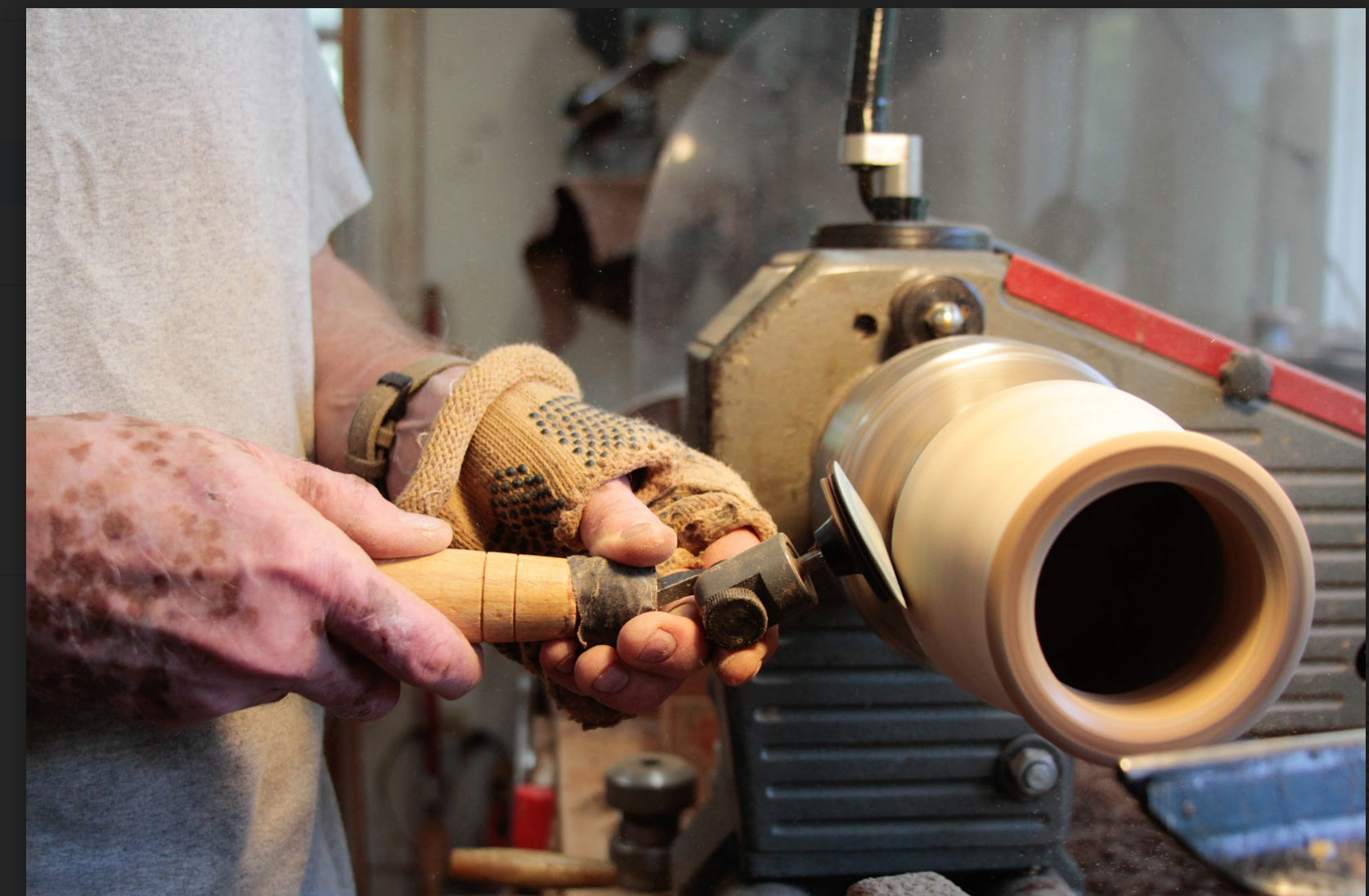
Eric Reeves, woodturner
Updates on Zamzam
Visit our archive of monthly updates chronicling activities and achievements in Zamzam.